



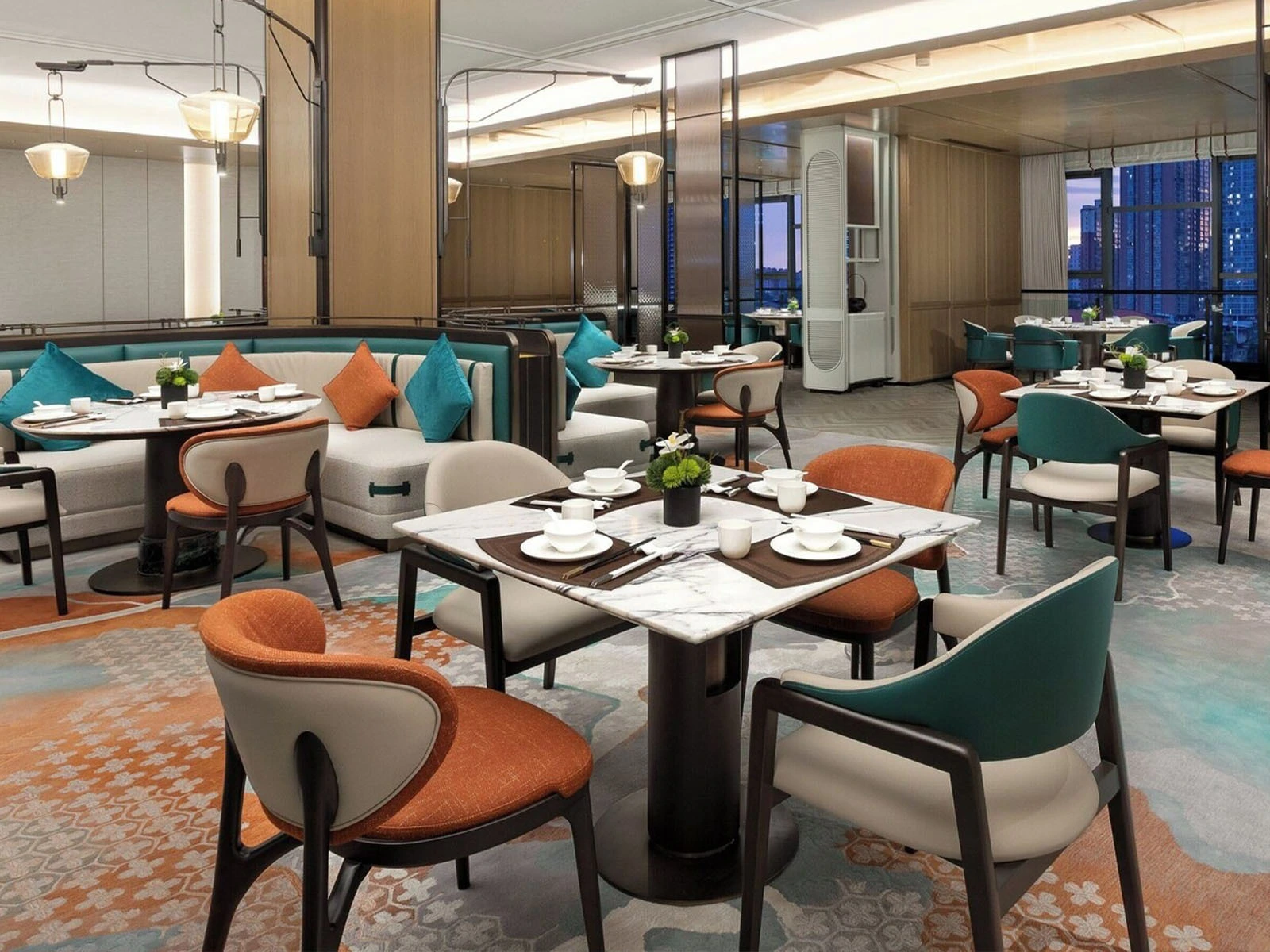
Dining Table
Scene Value: The central dining spot, providing a comfortable and functional area for guests to enjoy meals, fostering a pleasant dining experience.
Design Cohesion: Shapes, materials (wood, metal, or upholstered), and colors blend with the restaurant's style, from casual to upscale.
Craft Quality: Sturdy table frames and chairs with supportive seating, plus scratch-resistant tabletops suitable for daily dining.
As the absolute centerpiece of the dining space, the design style and type of the dining table directly influence the overall tone and atmosphere of the entire dining area.
In high-end hotel restaurants, the design of the dining table must not only fulfill basic dining functions but also serve as a visual focal point and artistic element within the space.
Modern minimalist style is currently the mainstream choice for high-end hotel restaurants, characterized by flowing lines, simple shapes, and an emphasis on the texture and color of the materials themselves.
For traditional style restaurants that pursue an elegant and dignified atmosphere, round or oval dining tables are more common.
These tables are usually paired with heavy solid wood bases, and the tabletops are made of marble or solid wood with natural textures, commonly found in high-end Chinese restaurants or formal banquet halls.
The choice of materials for high-end hotel restaurant dining tables is crucial in reflecting their quality and value.
The choice of tabletop material is particularly important because it not only withstands frequent use but is also the first thing guests notice.
Natural marble, with its unique texture, hard texture, and luxurious feel, has become the preferred material for high-end tabletops.
After fine polishing and resin sealing treatment, marble tabletops have excellent stain resistance, impermeability, and scratch resistance.
In addition to natural marble, sintered stone, as a new type of environmentally friendly material, has also become increasingly popular in recent years due to its excellent performance.
Made from natural stone fired at high temperature and pressure, it has extremely high hardness, scratch resistance, high temperature resistance, and corrosion resistance.
At the same time, its surface texture and color options are abundant, meeting more diverse design needs.
For the frame and base of the dining table, the choice of materials is equally diverse. Finely processed and treated solid wood table legs are not only structurally stable but also add a warm, natural touch to the space.
For restaurants pursuing a modern industrial or light luxury style, metal is also an ideal choice.
Through surface treatment processes such as electroplating and spraying, the table legs can present a variety of fashionable colors such as gold, black, or rose gold.
Their metallic luster complements the modern tabletop materials, jointly creating a cutting-edge and exquisite dining environment.
The design of dining tables in high-end hotel restaurants must fully consider their functionality and the needs of different application scenarios to maximize space efficiency and guest experience.
The choice of dining tables should match the restaurant's positioning and operating model.
In all-day buffet restaurants, the table layout needs to consider both smooth traffic flow and convenient access to food. Larger tabletops are typically used, along with double-sided serving designs, to improve operational efficiency.
In private rooms of high-end Chinese restaurants or specialty restaurants, the focus is on creating a private and distinguished dining experience.
Round tables are often preferred due to their ease of communication. Their size is usually customized based on the size of the private room and the number of guests to ensure that each guest has a comfortable dining space and social distance.