



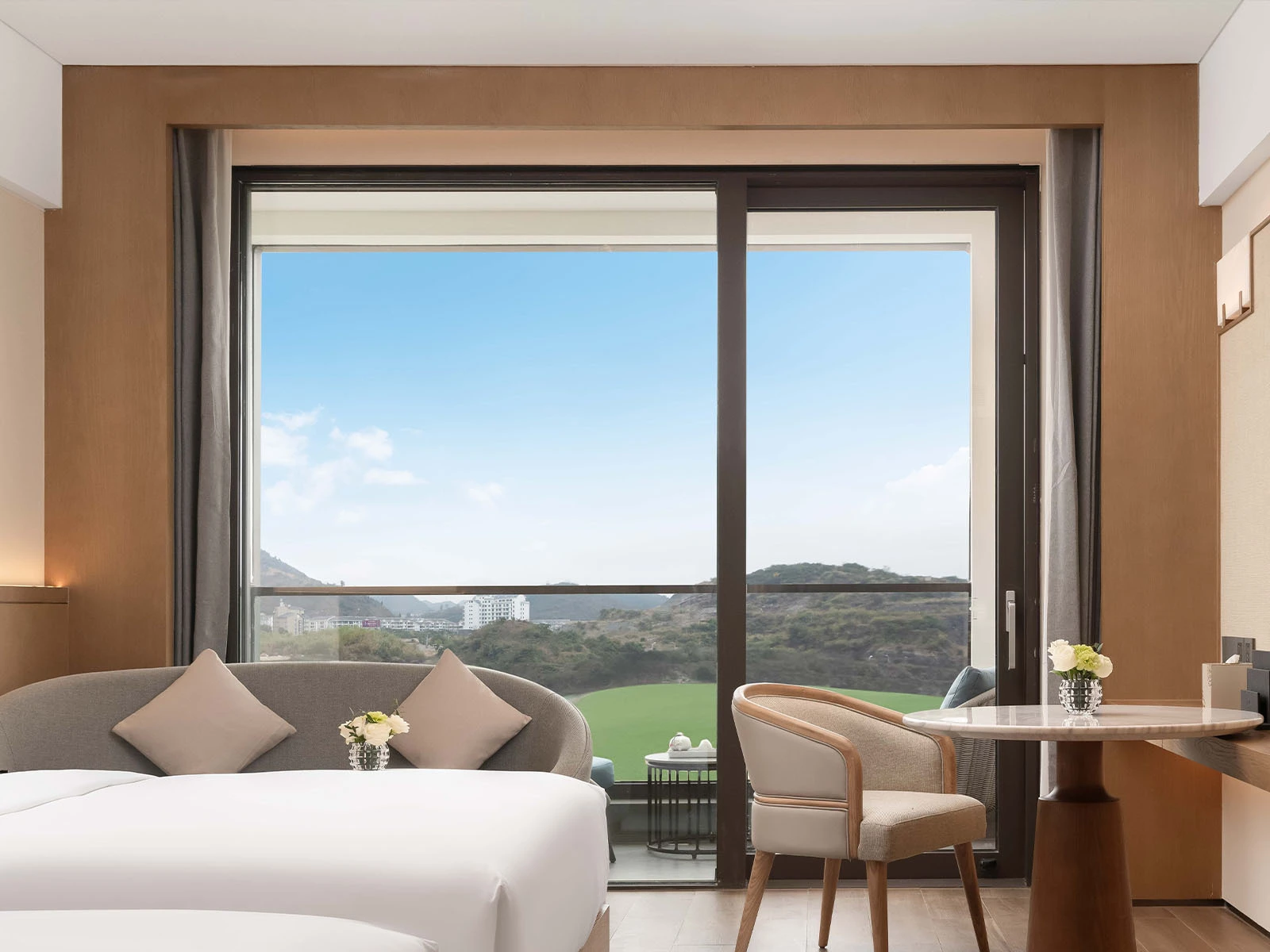
Window Frame
Design Cohesion: Door styles and handles coordinate with room cabinetry and design theme, built flush to walls for streamlined appearance.
Craft Quality: Smooth door operation and sturdy hanging rods handle heavy use, with interior finishes that resist scuffing from luggage and hangers.
Window frames, acting as a bridge connecting indoor and outdoor spaces, are designed to bring natural light and scenery indoors through careful selection of materials, lines, and colors, while harmonizing with the overall interior style.
In modern minimalist hotels, window frame designs typically prioritize simplicity and clean lines, employing narrow bezels to maximize glass surface area and create a bright, open visual experience.
Materials often include aluminum alloy or steel with a powder-coated finish, primarily in black, white, or gray, emphasizing clean lines and textured materials.
In Neo-Chinese or European classical styles, window frames can become details showcasing traditional craftsmanship and cultural heritage.
For example, solid wood frames can be used, adorned with exquisite carvings or lines, often in dark colors such as walnut or teak, to highlight their calm and elegance.
The design of the window frame also needs to coordinate with curtains, window sills, furniture, and other elements to create a comfortable and pleasant window-side space.
The choice of window frame material and manufacturing process directly affects its durability, sealing, and aesthetics. Commonly used materials include solid wood, aluminum alloy, PVC, and steel. Solid wood window frames have a warm texture and natural grain, offering excellent decorative appeal, but require professional anti-corrosion, insect-proofing, and moisture-proofing treatments to adapt to different climates.
Aluminum alloy window frames are high-strength, lightweight, corrosion-resistant, and easy to clean, making them the most commonly used material in modern hotels.
Through different surface treatment processes, such as spraying, electrophoresis, and wood grain transfer, rich colors and textures can be achieved.
PVC window frames offer good thermal insulation, sound insulation, and waterproofing, and are economical, making them suitable for areas with high performance requirements
Steel window frames are sturdy, durable, and have good fire resistance, often used in locations with high safety requirements. In terms of manufacturing processes, we emphasize the splicing and sealing of the window frames.
The corners of the window frames are typically welded or mechanically connected and finely polished to ensure their sturdiness and flatness. Professional sealing strips are used to seal the glass and window frame to prevent air leakage, water leakage, and noise intrusion.
The functionality and practicality of the window frame are mainly reflected in its lighting, ventilation, sound insulation, heat preservation, and safety.
Our production team possesses advanced processing equipment and extensive manufacturing experience, ensuring that all customized products are dimensionally accurate, of excellent quality, and comply with relevant national standards and industry specifications.
Window frames are used in all hotel spaces requiring lighting and ventilation, including guest rooms, lobbies, restaurants, conference rooms, and gyms.
The design and performance requirements of window frames differ in different application scenarios.
In guest rooms, window frame design needs to balance aesthetics, sound insulation, and safety to create a comfortable and quiet living environment.
In public areas such as lobbies or restaurants, window frame design needs to be more decorative, using large floor-to-ceiling windows or specially shaped windows to bring in more natural light and create a spacious and bright visual effect.
In functional areas such as conference rooms or gyms, window frames need to have good ventilation and heat preservation performance to meet different usage needs.
Furthermore, in certain specialized buildings, such as those with glass curtain walls or skylights, window frame design needs to be integrated with the overall building structure to achieve the best architectural effect.
Regardless of the setting, a well-designed and high-performance window frame can play a vital role in adding immeasurable value and brilliance to a hotel space.