



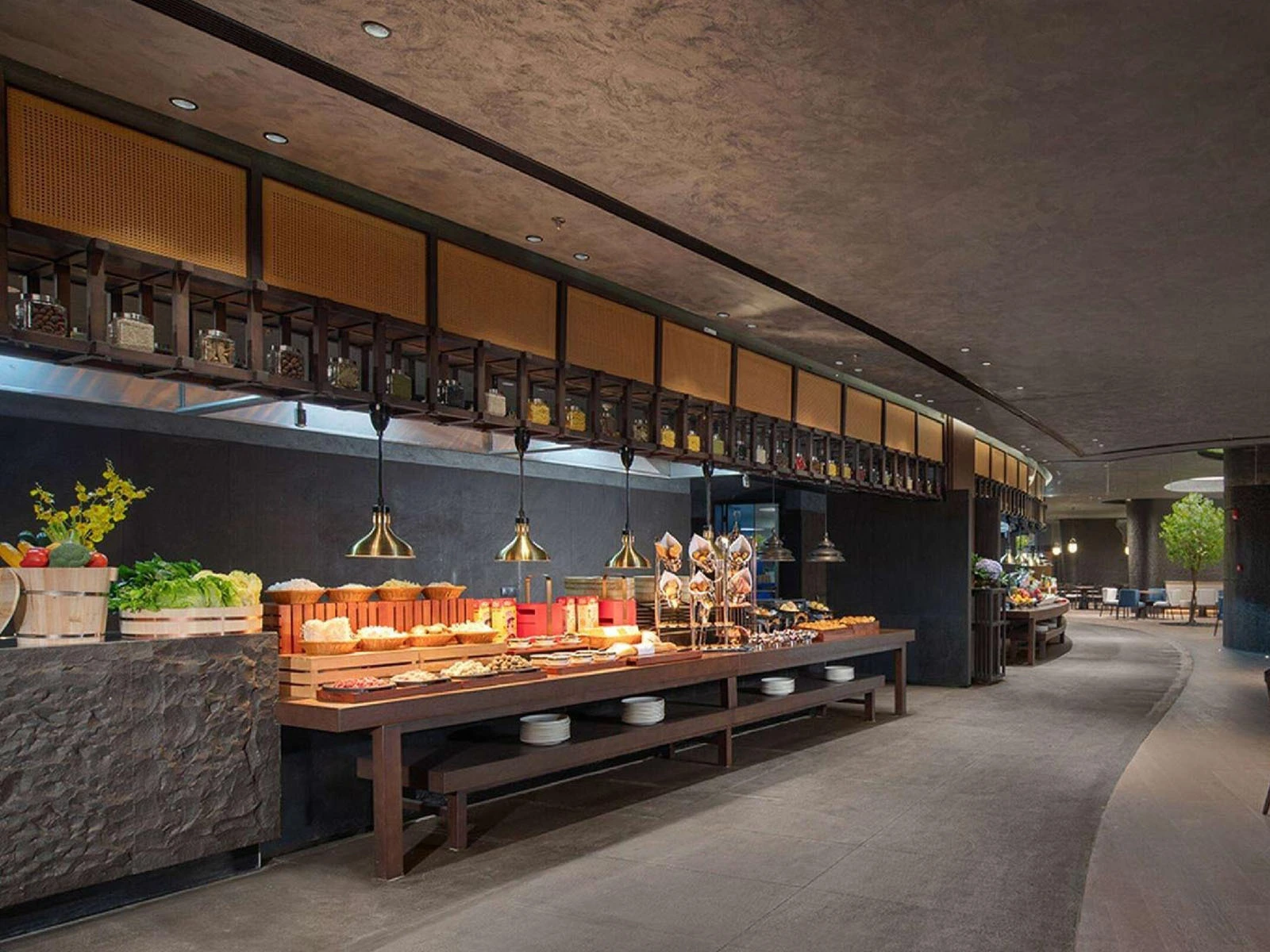
Buffet Table
Scene Value: Serves as a display and serving station for buffet-style dining, making it easy for guests to access food and enhancing the dining flow.
Design Cohesion: Styles (minimalist, industrial, or classic) and materials (wood, metal, or stone) match the restaurant’s theme, from modern to traditional.
Craft Quality: Smooth, easy-to-clean surfaces and sturdy construction to withstand frequent use and food spills.
As shared furniture in a buffet restaurant, the design of buffet tables must strike a perfect balance between efficient operation and aesthetic presentation. Their design style needs to be consistent with the overall positioning of the restaurant, while fully considering the needs of traffic flow, food serving lines, and food display.
In modern minimalist buffet restaurants, buffet table designs typically feature clean, flowing lines, emphasizing functionality and ease of cleaning.
The tabletops are often flat marble or wooden surfaces. The bases use simple metal or wooden structures, aiming for a visually lightweight feel.
For restaurants pursuing luxury or themed styles, buffet tables can become a highlight of the space design.
The most common styles are straight or L-shaped long tables, facilitating orderly food retrieval from one or both sides.
In addition, some high-end buffet tables integrate lifting functions, allowing the tabletop to be lowered during non-dining hours, blending seamlessly with the surrounding environment and increasing the multi-functionality of the space.
The material selection for high-end hotel buffet tables is crucial to ensuring their durability, hygiene, and aesthetics. Regarding tabletop materials, the requirements are extremely stringent due to direct contact with food and exposure to high temperatures, high humidity, and frequent cleaning.
Natural marble is an ideal choice for high-end buffet table tops due to its hardness, high temperature resistance, and resistance to bacterial growth.
Marble tabletops treated with food-grade resin sealant effectively prevent stain penetration and are easier to clean and maintain.
The choice of materials for the facades and bases is equally diverse. Solid wood veneer or fire-resistant laminate are widely used for the facade decoration of buffet tables due to their rich color and texture options, as well as their good wear and scratch resistance.
The product advantages of buffet tables lie in their high degree of functional integration and improved operational efficiency.
Through reasonable partitioning design, functions such as plate racks, cutlery storage, waste disposal, and napkin dispensers can be cleverly integrated into one or both ends of the table, forming a complete and efficient self-service unit.
This not only optimizes the guest's food retrieval flow and reduces congestion but also reduces the workload of the service staff and improves overall operational efficiency. The functional design of high-end hotel buffet tables aims to maximize the guest's dining experience and the restaurant's operational efficiency, resulting in a clearly defined application scenario. Functionally, the core design principles of buffet tables are "efficiency" and "convenience."
Firstly, the table height and width are ergonomically designed to ensure guests feel comfortable while serving themselves, without having to bend over or reach excessively.
Secondly, the food display area usually adopts a tiered or staggered design, making the food in the back rows clearly visible and convenient for guests to choose from.
To prevent food spills and maintain a clean surface, some tables also feature splash guards at the edges. In the hot food area, built-in heating equipment is essential to ensure that the food maintains its optimal temperature and texture throughout the dining period.
In terms of application scenarios, buffet tables are primarily used in hotel buffet breakfasts, all-day dining restaurants, banquet buffets, and catering service areas for large events. Their layout needs to be scientifically planned according to the restaurant's area, shape, and expected guest flow, usually adopting a "U," "loop," or "straight line" layout to create a smooth flow of traffic and avoid congestion.